Use Case — EU AI Act Compliance
Your AI agents are already regulated.
Most companies will find out the expensive way.
The EU AI Act is the world's first comprehensive AI law — and it has extraterritorial reach. If your agents serve a single user in the EU, you are in scope. Fines reach €35 million or 7% of global annual turnover, whichever is higher. There is no grandfathering. There is no good-faith exemption for "we didn't know what the model would do."
What non-compliance actually costs
€35M
or 7% of global revenue — prohibited AI violations
€15M
or 3% of global revenue — high-risk system failures
€7.5M
or 1.5% — incorrect or misleading information to authorities
Aug 2026
High-risk AI obligations enter into force
The control plane regulators expect
Compliance is no longer a document. It is a runtime system.
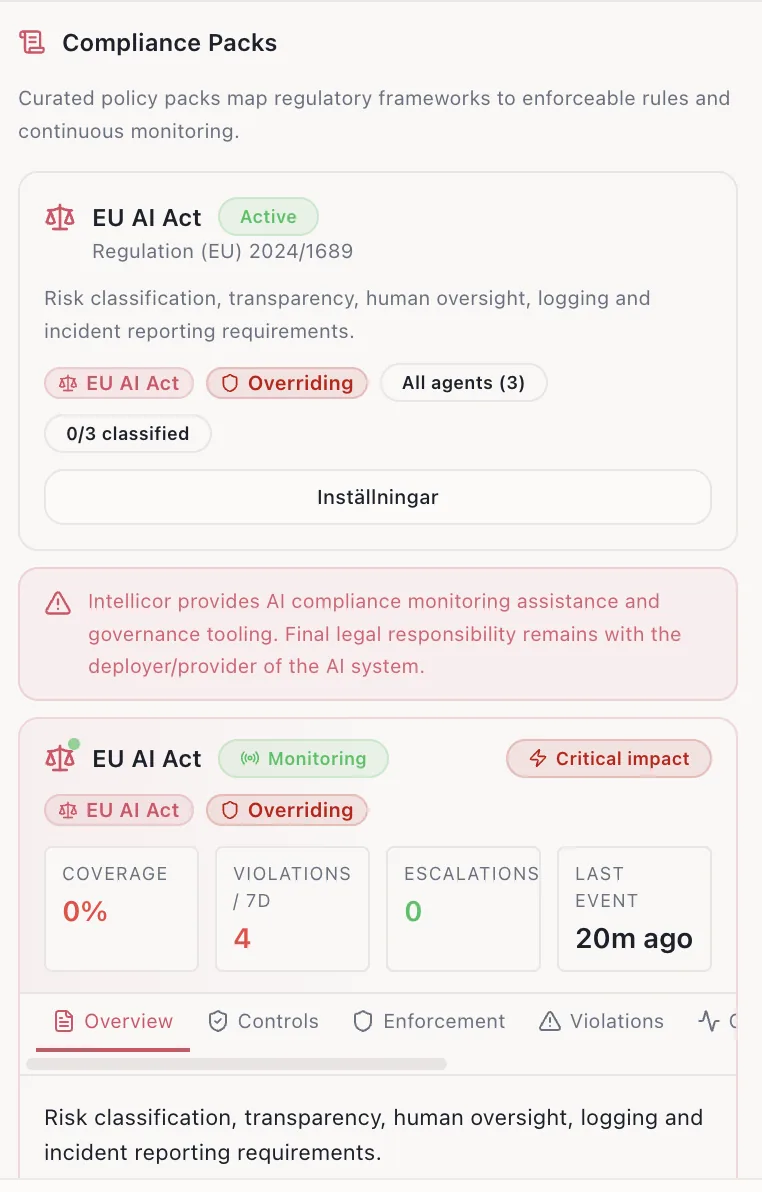
Intellicor activates EU AI Act, SOC2, and ISO 42001 policy packs across every agent in production — enforcing them on every action, logging every decision, and producing audit-ready evidence on demand.
From exposure to provable compliance
Today · The clock is already running
The EU AI Act is law — and it applies to your agents
Prohibited practices are banned since February 2025. General-purpose AI obligations took effect August 2025. High-risk system requirements become enforceable August 2026. If your AI agents touch hiring, credit, insurance, healthcare, education, critical infrastructure, or biometric data — they are high-risk. The clock is not waiting for your roadmap.
Penalties scale with global revenue, not local entity. A €35M fine is the floor, not the ceiling.
The Risk · Without a runtime control plane
Your AI agents are unprovable — and that is the violation
Article 9 demands a continuous risk management system. Article 12 demands automatic event logging across the agent's lifecycle. Article 14 demands effective human oversight. Article 15 demands accuracy, robustness, and cybersecurity guarantees that can be demonstrated to a regulator on request.
A model card and a Notion page are not a control plane. If you cannot reconstruct what an agent did, why it did it, and which policy was in force — you are non-compliant by definition.
Step 1 · Connect — agents under supervision
Bring every agent into the control plane
- ▸Every production agent registered, classified by AI Act risk tier, and tied to its provider/deployer obligations.
- ▸Shadow agents, rogue prompts, and unmanaged copilots become visible — you cannot govern what you cannot see.
- ▸Article 11 technical documentation generated and kept current automatically as the system evolves.
Step 2 · Activate — policy packs
EU AI Act, SOC2, ISO 42001 — enforced as code
Pre-built policy packs map directly to AI Act articles. Activate them and Intellicor begins enforcing fundamental rights protection, human oversight thresholds, transparency obligations, and prohibited-practice blocks at runtime — in every decision the agent attempts.
When the regulator asks how you comply with Article 14, you point to a live system, not a slide deck.
Step 3 · Runtime — every action validated
Prohibited and high-risk actions blocked before they execute
- ▸Social scoring, manipulative behavioral targeting, untargeted scraping for biometric DBs — hard-blocked at the control plane.
- ▸High-risk decisions (credit, hiring, healthcare triage) routed through enforced human oversight before customer impact.
- ▸Every refusal, escalation, and override logged with the policy version, evidence, and human-in-the-loop identity.
Step 4 · Continuous — drift, bias, incidents
Article 72 post-market monitoring, automated
Intellicor monitors your agents in production for performance drift, bias emergence, and serious incidents. The Article 73 incident reporting clock — 15 days for serious incidents, 2 days for widespread infringements — starts the moment something happens. Without continuous monitoring, you will miss it. With Intellicor, the report is half-written before your team is paged.
Regulators do not accept 'we didn't know' as a defense. Article 26 makes the deployer responsible.
Step 5 · On demand — regulator-grade evidence
Audit-ready, every minute of every day
Article 12 logs. Article 13 transparency records. Article 14 oversight evidence. Article 17 quality management documentation. All produced continuously, signed, immutable, and exportable. When the AI Office or a national market surveillance authority knocks, you hand over the system — not a project.
This is the difference between a fine and a clean inspection.
The uncomfortable truth
Most enterprises deploying AI agents today cannot, on demand, prove which policy was in force, what the agent decided, why it decided it, or who approved it. That is the exact gap the EU AI Act was written to penalize.
Your competitors are racing to ship agents. The ones who win this decade will not be the fastest to deploy — they will be the only ones who can prove their agents are safe, supervised, and lawful. Intellicor is how you become one of them before the first enforcement letter arrives.
Don't wait for the inspection